

Two teams ran the exact same dialer for the exact same 30 days. One booked a meeting every 240 dials. The other needed 824 to book one.
Nobody on either team was lazy. Both showed up, both made their numbers, both worked the phones all month. The gap wasn’t effort — it was everything that happens in the few seconds between the dial and the calendar invite. And once you see it in the data, you can’t unsee it.
So we pulled data on the platform and lined them up on one number: meetings booked per dial. The spread is brutal, the pattern is obvious, and the fix is something you can start coaching on Monday. Let’s get into it.
This Month’s Snapshot
We analyzed 1,257,329 dials from the last 30 days. Those dials produced 3,438 booked meetings. That’s the top of the funnel and the bottom of the funnel, and everything interesting lives in between.
The Funnel
Stage Count Rate from prior
Dials 1,257,329
Connects 111,032 - 8.8%
Conversations 39,873 - 35.9%
Meetings 3,438 - 8.6%
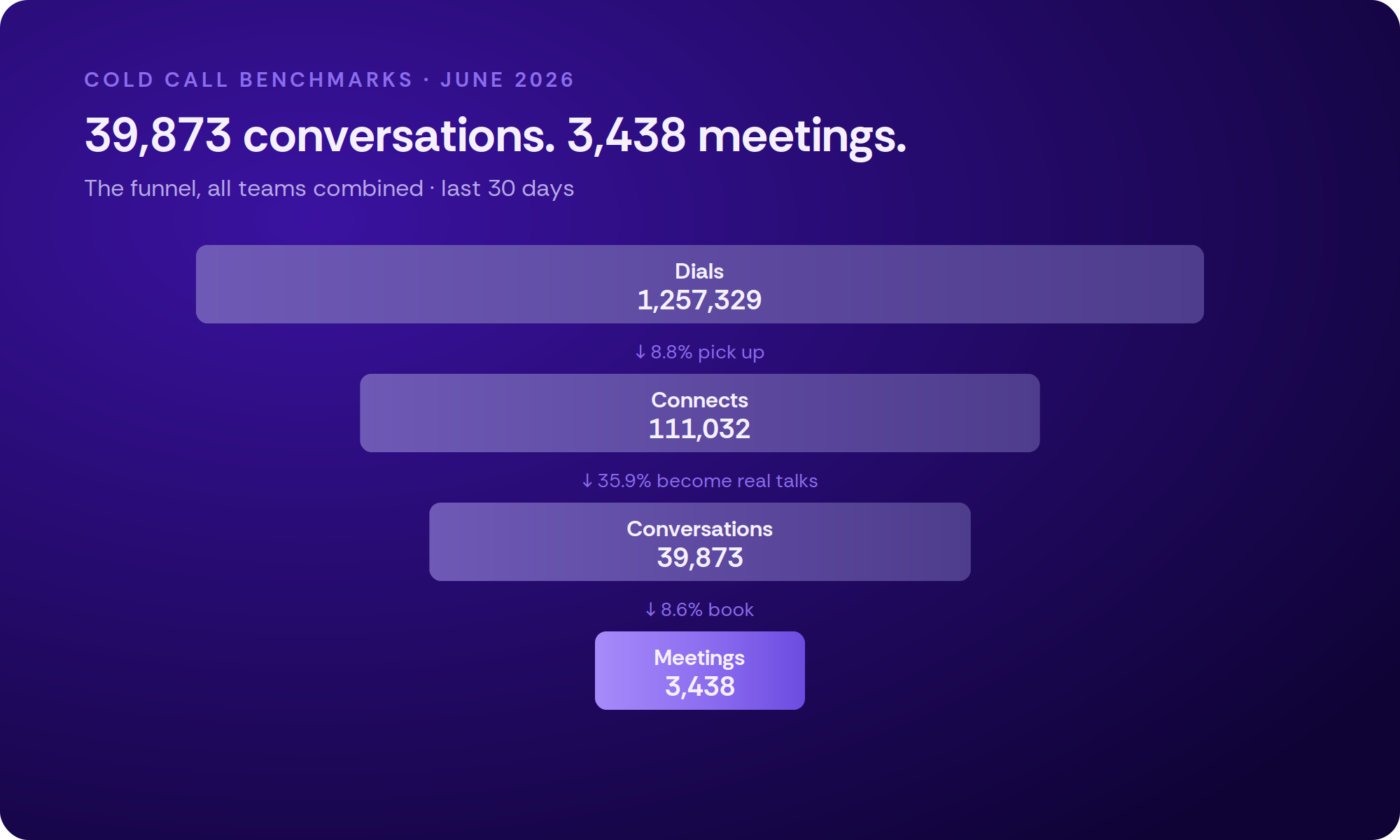
Heat Index: 🔥 Hot at the top, lukewarm in the middle. An 8.8% dial-to-connect rate is elite territory — these teams are reaching live humans at a rate most orgs only dream about. The engine is loud. The leak is downstream.
Hidden Gem: 39,873 conversations happened. Only 3,438 of them became meetings. That means 36,435 real, live conversations with a real human ended without a meeting on the calendar. That’s not a connect-rate problem. That’s a what-happens-after-the-connect problem — and it’s the single biggest pool of recoverable pipeline on the entire platform.
Why It Matters: If the average team converted conversations to meetings even a few points better, the platform would book hundreds of additional meetings a month from dials it’s already making. You’re paying for those conversations whether they convert or not.
Key Trend: Top Teams Don’t Dial More. They Dial Better.
Here’s the chart that should be on every sales floor this month.
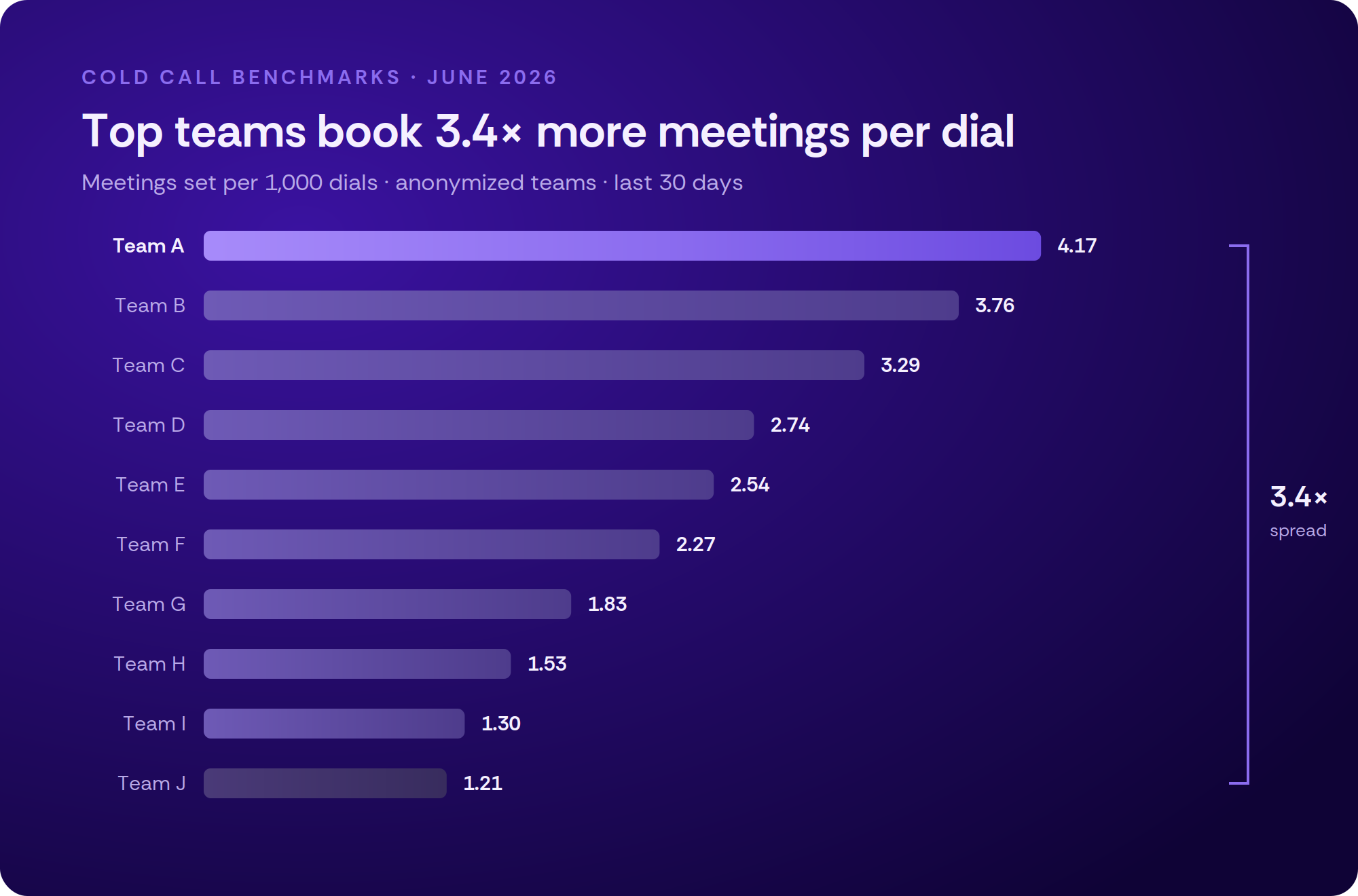
We took every team, divided meetings booked by dials made, and normalized it to meetings per 1,000 dials. The best teams on the platform book 4.17 meetings for every 1,000 dials. The team at the bottom of this group books 1.21. Same dialer. Same 30 days. A 3.4x efficiency gap.
Read that again, because it kills the most common myth in outbound: more dials = more meetings. The highest-volume team on the platform — the one that made over 200,000 dials — is a perfectly average converter. Meanwhile, one of the most efficient teams made a fraction of the dials and still out-converts them per attempt by a mile. Volume is table stakes. Conversion is the moat.
Why the gap exists: It comes down to the same four-step loop every outbound motion runs on —
Build a great account list
Find the relevant contacts
Call, book the obvious meetings, and salvage the conversations that don’t convert
Create follow-ups, then actually follow up
Build, call, follow up. That’s the entire job. Cold calling is a timing game — you can’t know if a prospect has budget frozen, a tool they love, or priorities pointed somewhere else today. You can’t control timing. You can control how many at-bats you get and how few you waste. Top teams don’t have better luck on timing. They run the loop with less leakage at every stage.
Test This: Stop benchmarking your reps on dial count for one week. Benchmark them on meetings per 1,000 dials instead. The leaderboard will reorder itself, and the reps who’ve been quietly converting will finally get visible credit — while the “grinders” who dial a thousand bad numbers a day get a reason to fix their inputs.
Quick Win: The Data-Hygiene Multiplier (Boss Mode + SmartEnrich)
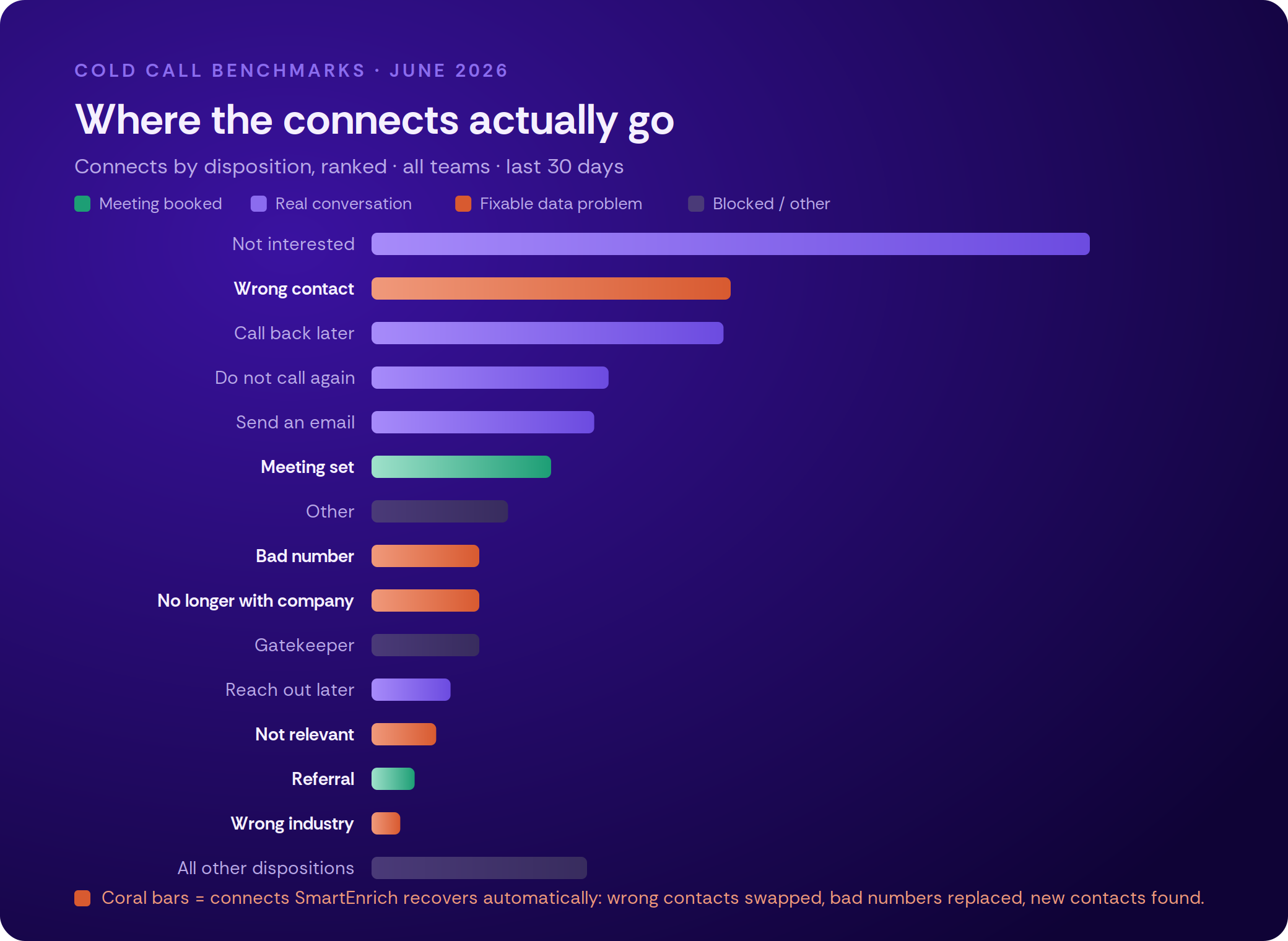
Look back at that funnel. Connect rate is elite at 8.8%, but only 35.9% of connects became actual conversations. A huge chunk of “connects” are landing on wrong contacts, dead numbers, and gatekeepers. That’s wasted at-bats — and it’s the most fixable number on the board.
The Tactic: Run validated numbers and live enrichment, every list, no exceptions.
Boss Mode validates phone numbers before the dial. Validated numbers pick up at meaningfully higher rates than raw list data — which means more connects turn into actual conversations instead of dead air.
SmartEnrich works during the motion: it automatically swaps out wrong numbers, finds a new contact when the one you have is wrong, and surfaces referrals — all inline, without your rep stopping to research.
By the Numbers: When 36.5K of your conversations are evaporating and “wrong contact” and “bad number” are among your top dispositions, every point you recover on data quality compounds straight through the funnel. A rep who spends 20% less time on dead numbers doesn’t just dial more — they dial into more live conversations, which is the only input that produces meetings.
Psychology Corner: Reps don’t quit because the job is hard. They quit because it feels pointless — dialing into voicemail and “this isn’t the right person” all morning erodes belief. Clean, validated, enriched data changes the emotional texture of the shift. More live humans means more momentum, and momentum is what keeps a rep on the phone.
Implementation:
Turn on Boss Mode validation for every list before it hits the dialer.
Enable SmartEnrich so wrong-contact swaps and referral discovery happen automatically.
Watch your connect-to-conversation rate — that 35.9% is the number to move.
Common Challenge: The 36,435 Conversations That Vanished
This is the big one. The platform had nearly 40,000 conversations and only 8.6% became meetings. The other 36,435 didn’t all say no — most of them said “not right now.” And “not right now” is not “no.” It’s a follow-up waiting to be created.
Diagnostic: Pull your own conversation-to-meeting rate. If you’re under ~10%, you don’t have a pitch problem — you have a follow-up problem. The meeting that doesn’t happen on call #1 happens on call #3, #5, or #8 — if someone schedules the next touch. Most reps don’t. They have the conversation, hang up, and the lead dies of neglect.
Root Cause: Two things. First, no disciplined follow-up step in the workflow — the conversation ends and nothing gets created. Second, reps give up too early. A prospect who’s “in a conversation” but not yet a meeting needs persistence, and too many reps fold after a couple of touches, right before the timing finally lines up.
Solution Matrix:
Quick fix: Make it a rule — no conversation ends without a follow-up created. Every “call me later,” every “send me an email,” every “wrong time” becomes a scheduled next touch before the rep moves on.
Medium fix: Build a standing block of warm follow-ups into each day. These convert far better than cold dials because the relationship already started.
Deep fix: Coach persistence explicitly. Track touches-to-meeting per rep and surface the reps folding early. The meeting you’re missing is usually one or two touches past where someone quit.
Coaching Prompt: “You had 40 conversations last week and booked 3 meetings. I’m not worried about the pitch — I heard it, it’s good. I want to know what happened to the other 37. Walk me through where each of them is in your follow-up sequence right now.”
Tip of the Month: Don’t Dial Alone
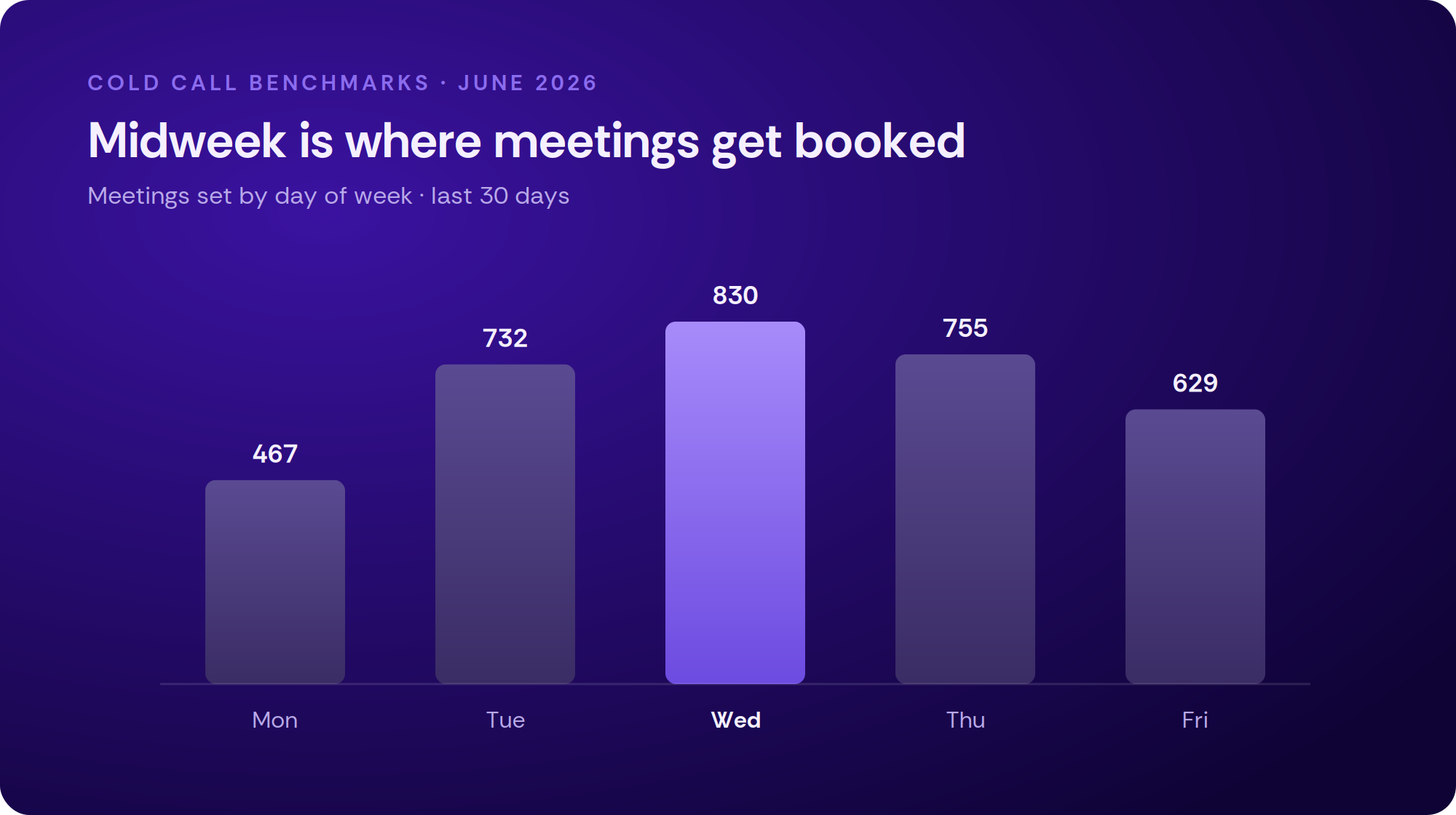
Here’s a pattern hiding in the activity data: dialing happens in waves that track the team rhythm — heavy midweek, near-zero on weekends — and the teams that join the sales floor together sustain those waves far longer than reps grinding solo.
Solo dialing is where give-up happens. Nobody’s watching, the morning’s been rough, and the rep quietly stops at 11am. On a live sales floor, you feel the energy, you hear someone book a meeting two seats over, and you stay in the chair. Reps who don’t dial together are the ones most likely to stop early — right before the meeting that was about to happen. Same talent, different environment, completely different output. Get your team on the floor together.
Your Action Step This Month
What: Pick your single lowest-efficiency rep or pod and run a 2-week “top team” sprint. Three rules: (1) every list runs Boss Mode validated + Smart & Rich enriched before dialing, (2) no conversation ends without a follow-up created, (3) they dial on the sales floor with the team, not solo.
When: Kick it off at your next Monday standup. Two full weeks, no exceptions.
How to Measure: Track meetings per 1,000 dials and connect-to-conversation rate before and after. Those are the two numbers that separate the top teams from the average ones — move them and everything downstream follows.
Watch Out For: Reps will frame validated/enriched lists as “fewer numbers to dial” and resist. Reframe it: you’re not cutting their volume, you’re cutting their wasted volume. Same hours, more live humans, more meetings. That’s the entire difference between a top team and an average one — and now you’ve got the playbook to close the gap.
The Call Report is published by Cold Call Benchmarks at Salesfinity.ai
Interesting insights, thanks for sharing