

The Intelligence Brief
This week we 265,432 dials, which resulted in 17,950 live humans. Good. But only 7,104 of those connects became actual conversations. That’s a 39.6% connect-to-conversation rate, which means 60.4% of your live connects are dead on arrival — wrong contacts, gatekeepers, immediate hang-ups, or reps fumbling the first 8 seconds.
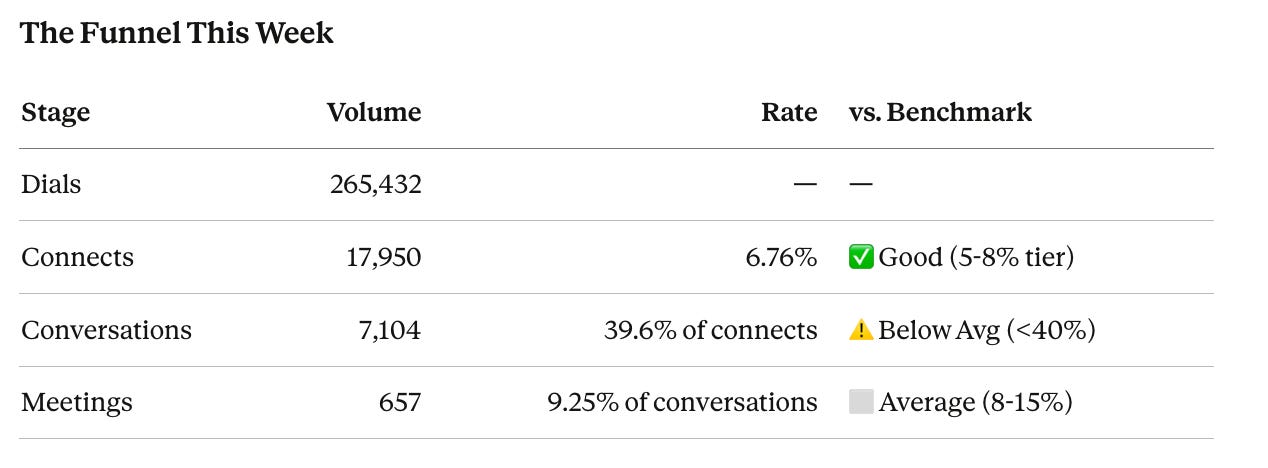
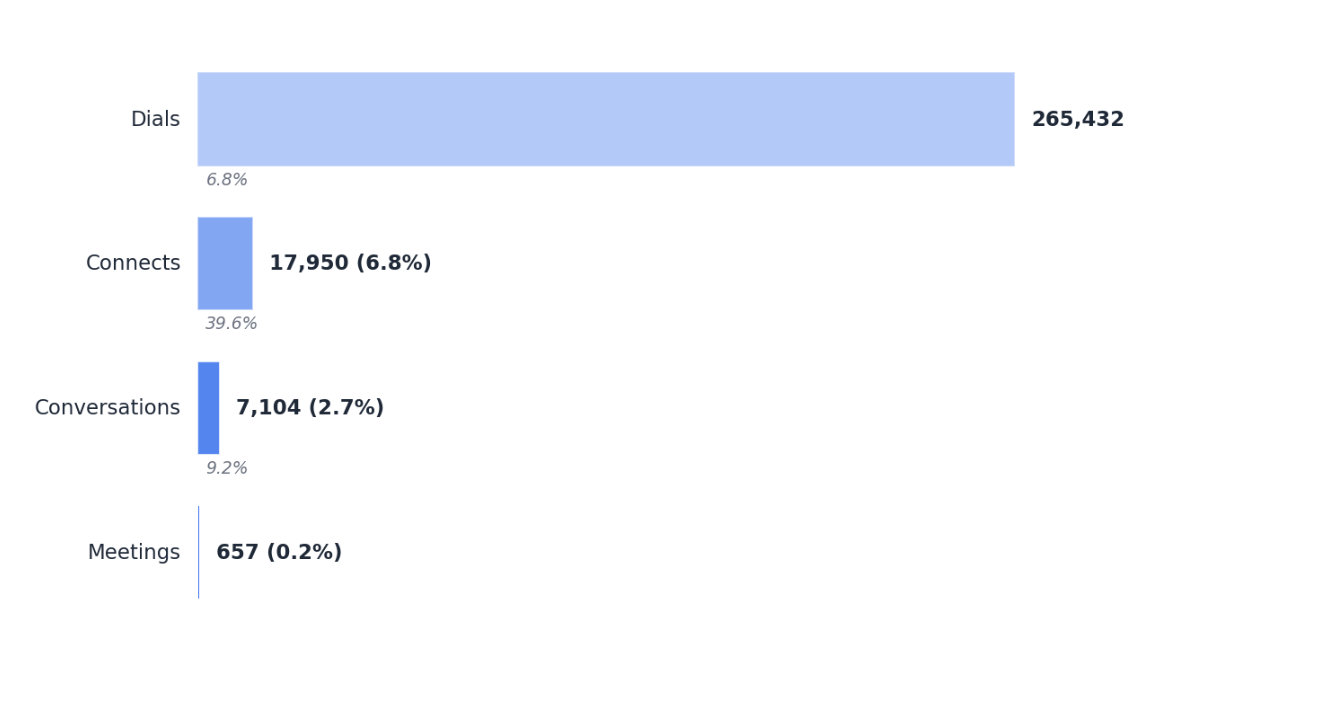
Network Benchmark: The 6.76% dial-to-connect rate places the network in the “Good” tier this week — above the industry average of 3-5%. But the 39.6% connect-to-conversation rate is the constraint. It’s sitting at the floor of the “Below Average” threshold, dragging an otherwise healthy top-of-funnel into a 0.248% dial-to-meeting rate.
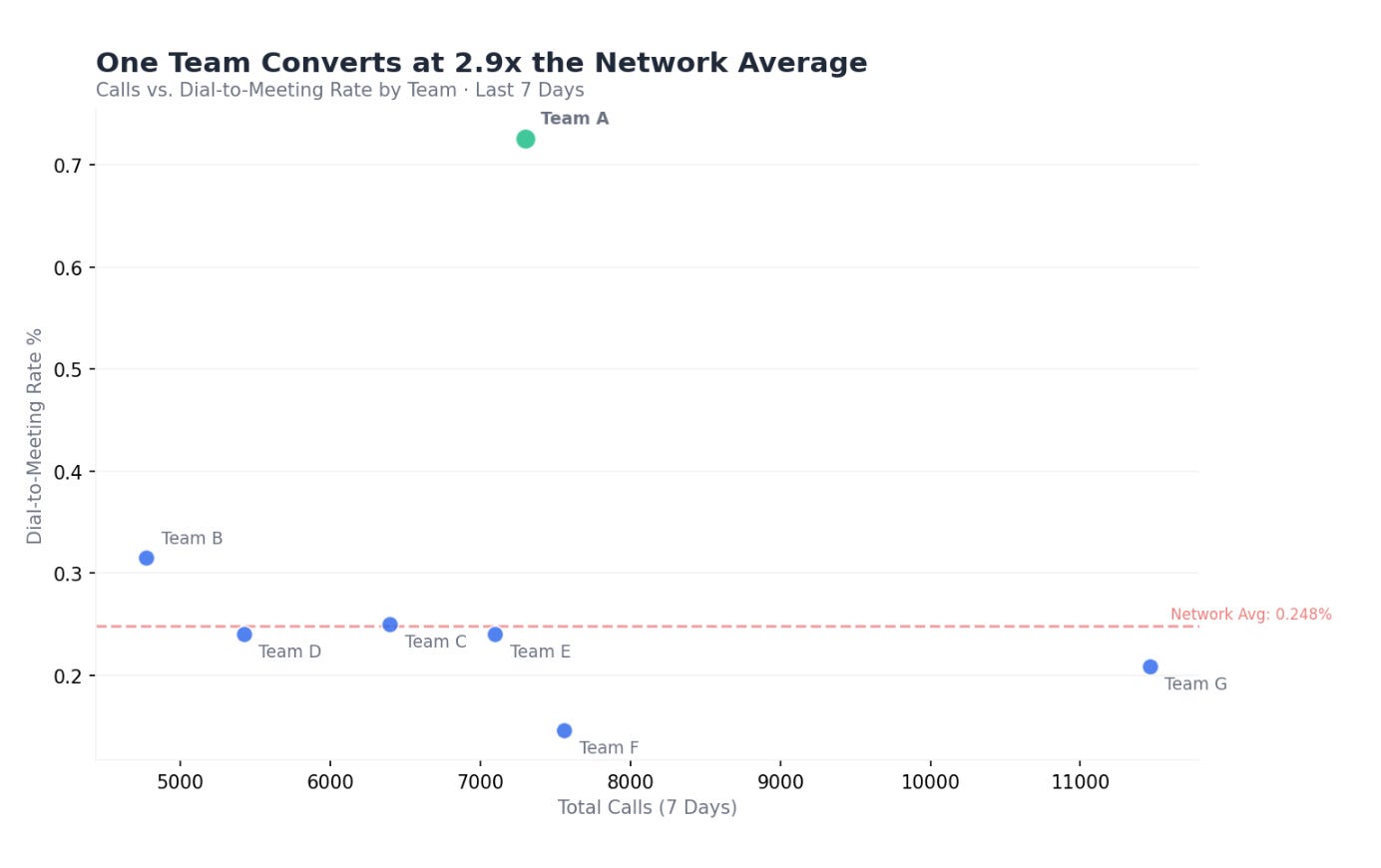
The Buried Signal: The gap between the best and worst teams on the platform is massive. The top 5% of teams are converting dials to meetings at 2.9x the network average — not because they dial more, but because they convert connects to conversations at dramatically higher rates. One top-performing team booked 53 meetings from ~7,300 dials (0.73% D2M) while a higher-volume team needed 11,400+ dials to book 24 meetings (0.21% D2M). Same platform, same week, 3.5x efficiency gap.
Revenue Context: At a mid-market SaaS ACV of $50K and a 20% pipeline-to-close rate, each additional meeting represents approximately $10,000 in expected revenue. The connect-to-conversation gap represents roughly 280 lost meetings per week network-wide — or $2.8M in annual revenue left on the table.
The Deep Dive
The Salesfinity network is good at getting people to pick up the phone — 6.76% connect rate, solidly in the “Good” tier. And when reps do get into a real conversation, they convert to meetings at a respectable 9.25%. The main leak is in between.
Of the 10,846 connects that didn’t become conversations this week, the disposition data reveals a clear pattern:
“Not Interested” is the dominant disposition — by a wide margin. But here’s what most managers miss: a significant chunk of “Not Interested” outcomes happen within the first 30 seconds of the call. These aren’t prospects who evaluated your offer and made a rational decision. These are prospects who pattern-matched the call as a sales call and ejected before the rep could earn 15 more seconds of attention.
“Wrong Contact” is the second-largest disposition. This isn’t a calling problem — it’s a data problem. Every wrong contact consumes a connect that could have been a conversation. Teams seeing wrong-contact rates above 15% of their connects should stop adding volume and start cleaning lists.
“Call Back Later” is the third-largest. This is actually the most optimistic non-conversion disposition — these are warm leads who picked up and acknowledged enough interest to request a callback. The question most teams never answer: how many of these callbacks actually happen? If you’re not tracking callback completion rate, you’re leaking pipeline.
What to do: The highest-leverage intervention is an opener audit. Have every rep record their first 10 seconds on 20 calls this week. The pattern you’ll likely find: reps who convert connects to conversations at >50% pause after their name, ask a context-setting question, and don’t pitch within the first 15 seconds. Reps below 35% lead with their company name and a value prop that sounds like every other SDR who called that day.
Expected impact: Teams on the Salesfinity platform that have implemented structured opener training typically see a 5-10pp lift in connect-to-conversation rate within 3 weeks. Even a 5pp improvement (39.6% → 44.6%) would mean ~898 additional conversations per week and ~83 additional meetings — an $830K annualized revenue lift at mid-market ACV assumptions.
How to measure: Track connect-to-conversation rate at the rep level, weekly. If it doesn’t move 3pp within two weeks of the intervention, the issue isn’t the opener — it’s list quality or targeting.
The Coaching Play: The “Volume Machine” Trap
Across the Salesfinity network this week, the teams dialing the most are not the teams booking the most meetings. The data shows a clear negative correlation between pure call volume and dial-to-meeting efficiency.
The highest-volume team on the platform made 11,400+ dials and booked 24 meetings (0.21% D2M). A team making 36% fewer dials booked 2.2x more meetings. This is the Volume Machine archetype — teams or reps who are crushing activity metrics but underperforming on conversion. The instinct is to praise the volume. The correct response is to diagnose the conversion.
The 1:1 Script (for any manager coaching a Volume Machine rep):
“I want to start by acknowledging your dial volume — it shows real discipline, and that’s not the issue. What I want to explore together is why we’re converting at [their rate] when top teams on the same platform are at 0.73% with fewer dials. I don’t think this is a skill gap — I think it’s a targeting or timing gap. Can we pull up your last 20 connects and look at who you’re reaching and what happens in the first 10 seconds?”
The Diagnostic: Pull your team’s disposition data. If “Wrong Contact” + “No Longer with Company” + “Bad Number” exceeds 25% of connects, the problem is upstream — it’s list quality, not caller skill. Redirect effort from more dials to better data before adding volume.
The Benchmark: Teams that shift from volume-first to efficiency-first (reallocating 20% of dial time to list research and enrichment) typically see a 40-60% improvement in dial-to-meeting rate within 4 weeks, with no reduction in total meetings booked.
The Quick Win: Steal Thursday’s Dials, Give Them to Friday
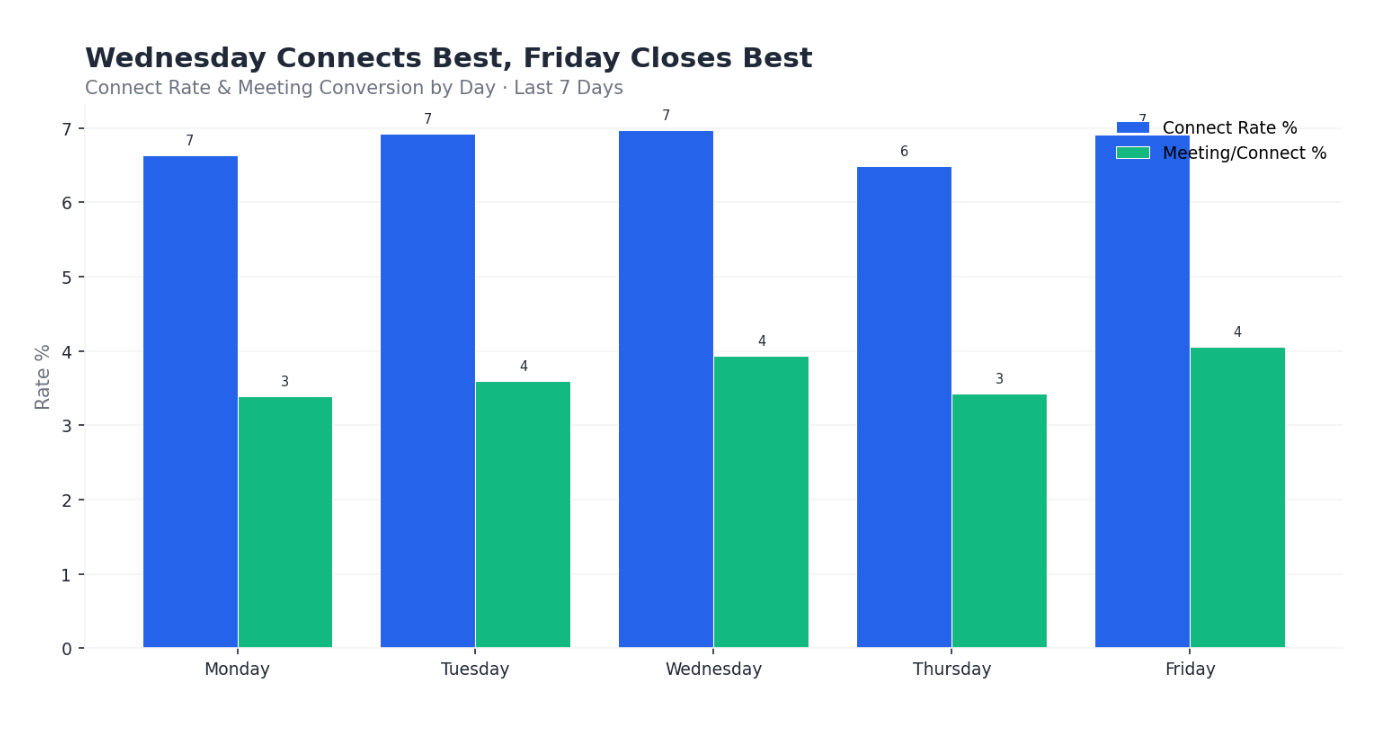
Here’s a data point most managers would skim past: Friday has the highest meeting-per-connect rate on the Salesfinity network at 4.06% — 20% higher than Thursday (3.43%) and 20% higher than Monday (3.39%).
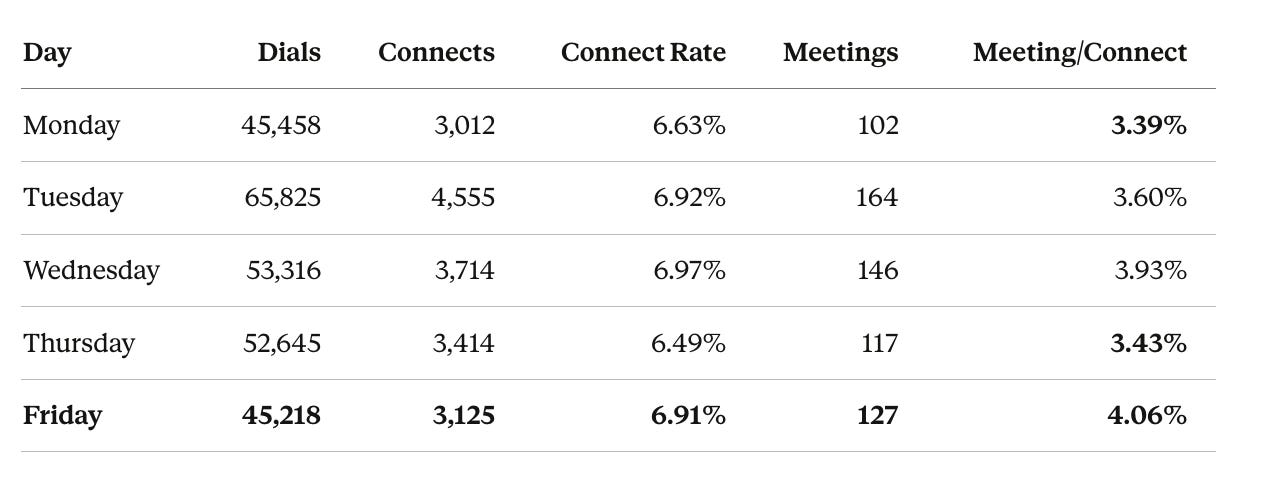
Yet Thursday and Friday get nearly identical dial volumes from teams. Shift 15% of Thursday’s volume to Friday. Thursday is the worst-performing day for meeting conversion — prospects are in mid-week meeting gridlock and screening calls. By Friday, they’ve cleared their calendar backlog and are in “close loops before the weekend” mode — more receptive to booking a quick call for next week.
Expected impact: Redirecting ~7,900 dials from Thursday to Friday at Friday’s superior conversion rate could yield approximately 8-12 additional meetings per week.
Your Move
Pull your team’s connect-to-conversation rate this week. Not your connect rate — your conversation rate. If it’s below 45%, your problem isn’t at the top of the funnel. It’s in the first 15 seconds after someone picks up the phone. Record your reps’ openers this week. The gap between your best and worst converter will tell you exactly where to coach.
Do it before your Thursday standup.
The Call Report is published weekly by Cold Call Benchmarks at Salesfinity.ai — the only cold-calling newsletter backed by data from 1000s of SDRs making millions of dials monthly. Got data you want analyzed? Reply to this email.
Data powered by Salesfinity
The bottleneck is rarely the product; it’s that the market can't decode what you actually do in under five seconds. Clarity is the ultimate pricing lever.