

The headline: meeting volume is downstream of two controllables most teams ignore:
Number quality (validation + enrichment) → raises connect rate
Follow-up intensity (calling warm “good fit, not now” leads) → raises conversion
Funnel totals
Dials: 291,500
Connects: 19,662
Conversations (1+ min): 7,721
Meetings booked: 679
Funnel efficiency (benchmarks)
Dial → Connect: 6.74%
Connect → Conversation: 39.3%
Conversation → Meeting: 8.79%
Dial → Meeting: 0.233%
Cost of a meeting: ~429 dials (blended average)
Day-of-Week Benchmarks (where the week is won)
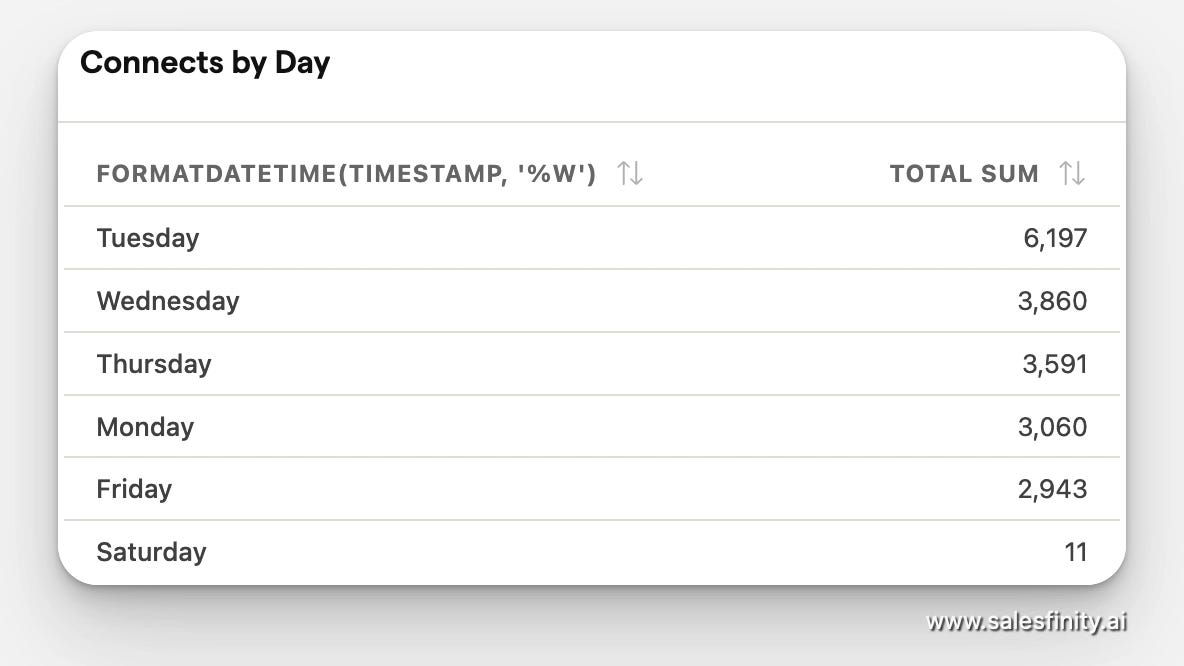
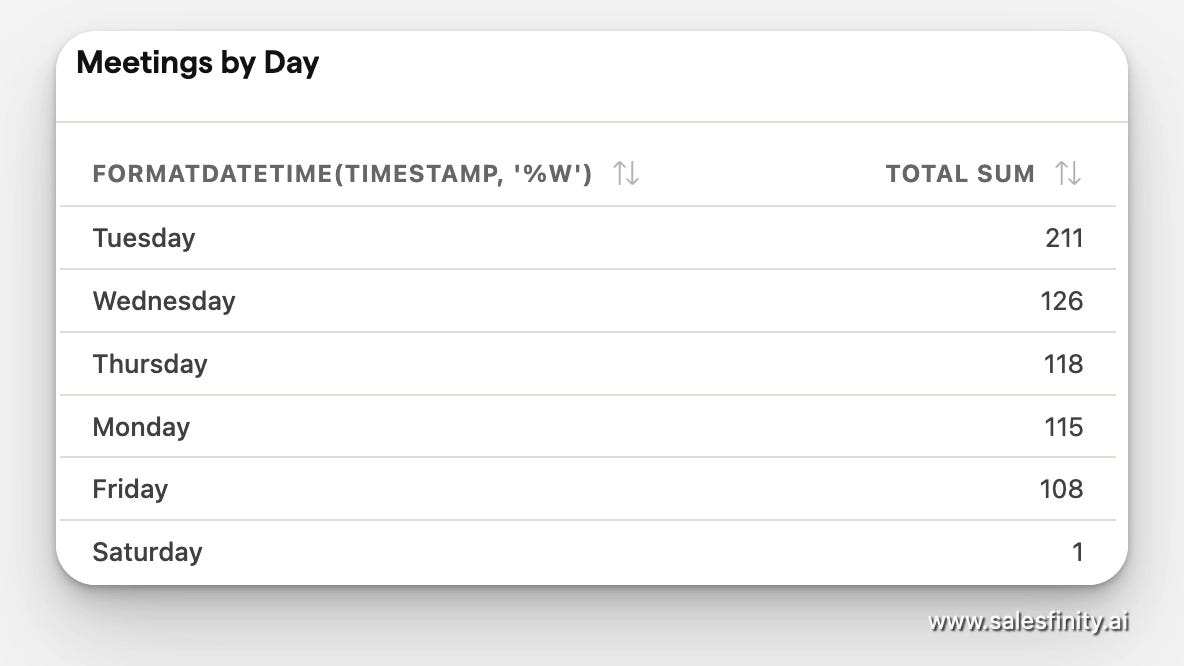
Here’s the reality: not all days behave the same, even with similar effort.
What that means (benchmarks)
Tuesday produced ~31% of all meetings (211 / 679) — the most productive day.
Connect rate peaks happen when number quality is highest (more on that below).
Call Outcome Benchmarks (Dispositions)
Most teams only track “meetings.” Winners track what creates meetings.
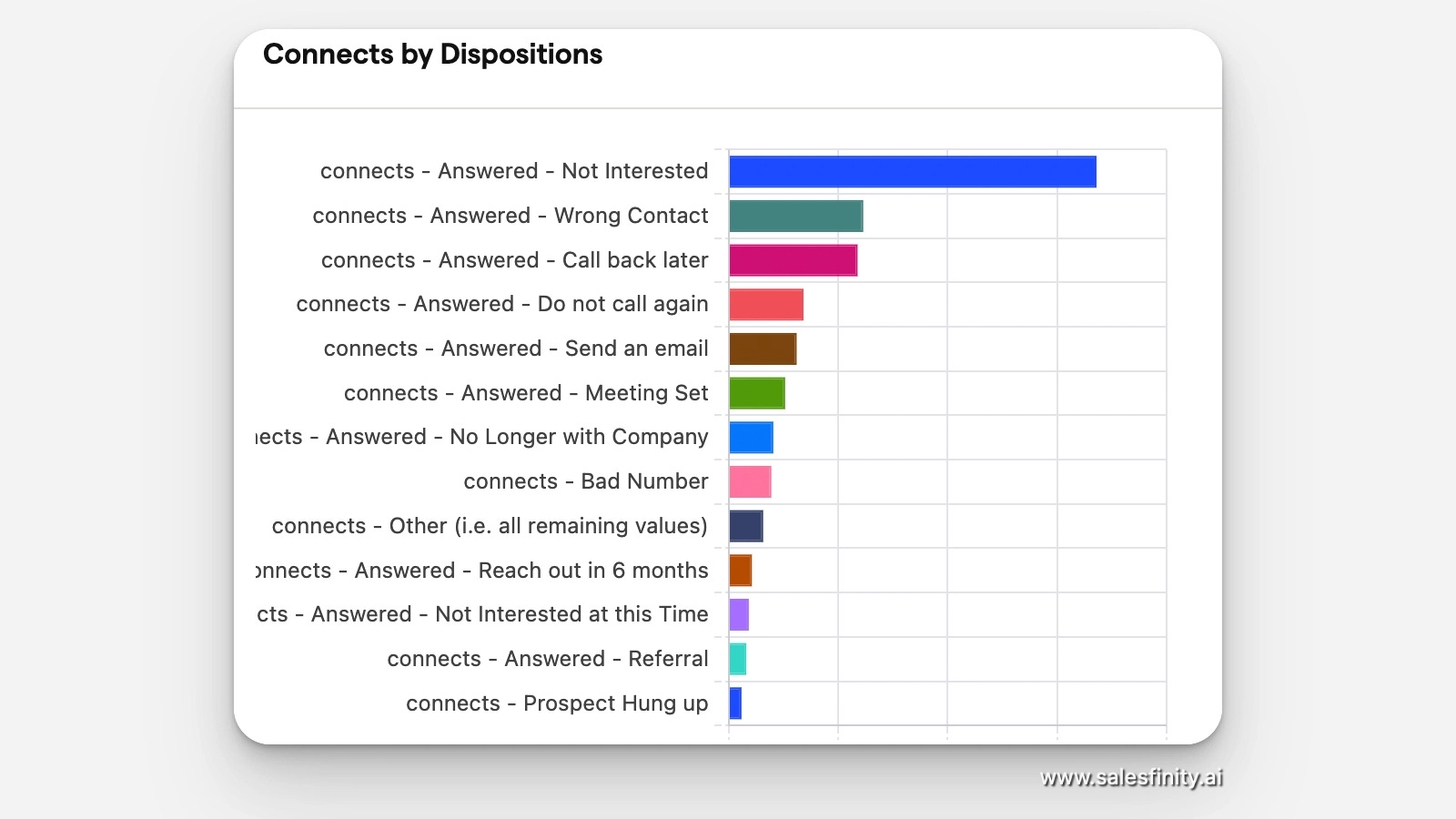
Based on connect outcomes this week, the distribution looks like this (shares of connects):
Answered → Not Interested: ~39%
Answered → Wrong Contact: ~14%
Answered → Call back later: ~13%
Answered → Do not call again: ~8%
Answered → Send an email: ~7%
Answered → Meeting set: ~6%
Remaining outcomes (no longer there, bad number, other, reach out later, etc.): ~13%
Two key takeaways for SDR leaders:
“Not Interested” is normal volume. The question is: are you logging why?
“Call back later” + “Reach out in X months” are future meetings hiding in plain sight. If you don’t operationalize follow-up, you’ll be stuck on the new-list hamster wheel forever.
The Analytical Part: Do validation, enrichment, and follow-ups correlate with meetings?
How we measured this
We treated internal usage intensity as a proxy for operational behavior:
Validation intensity ≈ how aggressively teams filter/prioritize reachable numbers
Enrichment intensity ≈ how often teams refresh missing/old contact data
Follow-up workflow intensity ≈ how much time teams spend mining + calling “known” prospects
Then we compared those daily usage signals against:
Connect rate (connects/dials)
Meeting rate per dial (meetings/dials)
Meeting totals
Important: this is correlation, not causation, and the sample is one week. But the relationships are strong enough to give leaders a practical playbook.
1) Number Validation Intensity vs Connect Rate
Finding: days with higher validation intensity tended to have higher connect rates.
Why it makes sense:
connect rate is primarily a function of reachability
if you remove dead/unreachable numbers from the dial stream, you speak to more humans per hour
more humans → more conversations → more meetings
Manager takeaway:
If your connect rate is under ~6–7%, don’t “fix the script” first.
Fix the phone data first. Script optimization is downstream.
2) SmartEnrich (Enrichment) vs Connect Rate
Finding: enrichment intensity showed a positive relationship with connect rate and a clear relationship with stability.
This shows up as:
fewer “bad number” events over time
fewer wrong contacts
fewer wasted dials (silent productivity killer)
Manager takeaway:
Enrichment isn’t a growth hack. It’s pipeline hygiene.
Teams that enrich routinely don’t “spike” as much — but they stop bleeding efficiency.
3) Follow-Up Workflows (Nurture AI behavior proxy) and Meeting Efficiency
This is where the biggest money is.
Your own benchmark principle holds:
Cold list meetings on first touch are low-probability (this week’s funnel supports that)
Follow-up conversations convert 2–4x higher (industry-consistent, and supported by the shape of outcomes: “call back later,” “reach out later,” “existing solution” etc.)
The data pattern this week:
A meaningful chunk of connects are future-pipeline dispositions (“call back later,” “reach out later”)
Teams who operationalize this bucket (store, categorize, re-run) compound
Teams who don’t… restart from zero every morning
Manager takeaway:
Your org doesn’t have a “volume problem.”
It has a follow-up inventory management problem.
What Top Teams Are Doing
Across the best-performing segments this week, we consistently saw:
1) They engineer connect rate before they chase activity
validation + enrichment practices are visible upstream
reps talk to more humans per hour
managers get more coaching reps per day (more calls to review)
2) They treat follow-ups as premium inventory (not leftovers)
follow-up blocks are scheduled (daily or 3x/week)
dispositions are categorized (timing, budget, existing vendor, champion left, etc.)
follow-ups are run like campaigns, not reminders
3) They measure “connects per hour” and “conversations per hour”
Not just dials/day.
Dials are cheap. Humans are scarce.
Your Tactical Playbook for Next Week
If you want more meetings without increasing headcount:
Step 1 — Fix number quality (this improves connects)
validate numbers and prioritize reachable ones
enrich missing/outdated numbers weekly
track “bad number” and “wrong contact” as a leading indicator
Step 2 — Build a follow-up engine (this improves conversion)
Create a CRM view for:
Call back later
Existing solution / existing vendor
Reach out in X months
Not now
Budget / timing
Then schedule dedicated follow-up dialing blocks.
Step 3 — Track these 3 KPIs (weekly)
Connect rate (goal: stabilize >6–7%)
Conversation rate (connect → 1+ min) (goal: >35–40%)
Meeting rate (conversation → meeting) (goal: >8–10%)
Ready to turn connects into meetings—without just dialing more? Try the Salesfinity AI Dialer for free and build a smarter outbound engine with better number quality and automated follow-up workflows.